
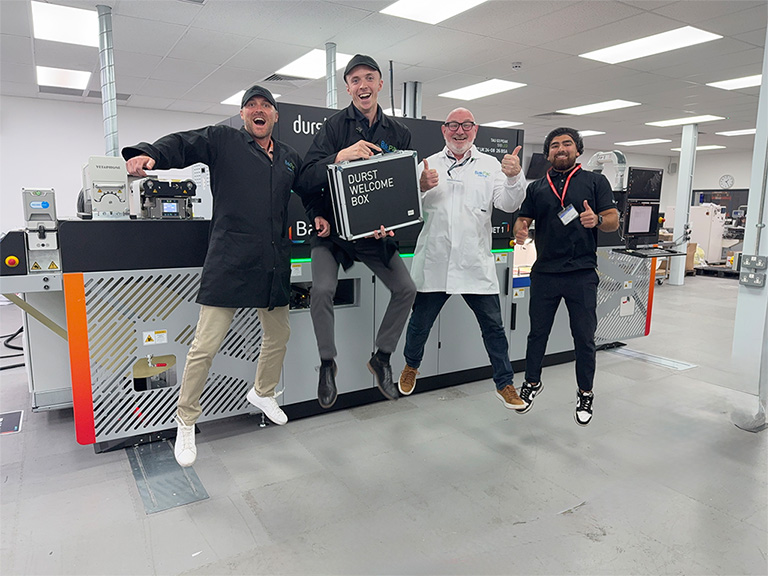
There’s been a fairly significant new arrival in the Baker Labels factory.
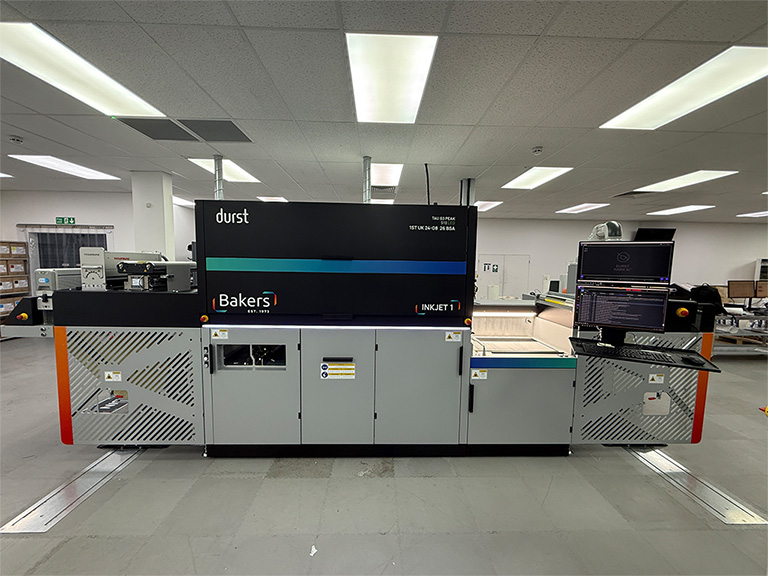
Our new Durst Tau G3 Peak LED was delivered to Brentwood on Monday 24 August, making Baker Labels the first company in the UK to install the new press.
The Durst engineering team spent the next few days getting everything into position, carrying out the installation and working through the commissioning process. By Thursday, the main installation was complete and attention had moved on to trials, operator training and, importantly, putting some real work through the press.
We’ve already run the first official customer job, so the G3 Peak is quickly moving from being the shiny new machine in the factory to becoming part of everyday production.
This is also a significant investment specifically in the future of Baker Labels. There’s been plenty of growth and investment across the wider Bakers business, but labels remain at the heart of what we do, and we see plenty more opportunity ahead.
Why a second Durst Press?
The G3 Peak joins our existing Durst Tau RSC 340 LED, which has become an important part of our digital label production since it was installed.
So perhaps the simplest explanation for buying a second Durst is that the first one did what we needed it to do.
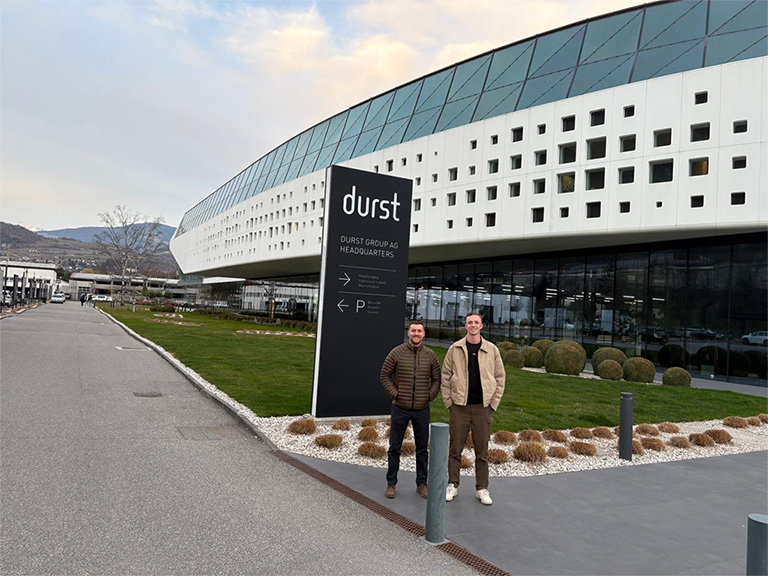
Earlier this year, Tom Baker and Technical Manager Jamie Godson travelled to Durst’s headquarters in Brixen, Italy, to look at the next generation of Tau technology and agree the investment.
We knew we wanted more capacity, but the conversation developed beyond simply adding another digital press. By the time the final specification was agreed, we had chosen to go considerably wider.
Moving up to 510mm
Our new Tau G3 Peak has a 510mm web width, and that decision is an important part of why this investment is interesting to us.
The extra width gives us a straightforward production advantage: more output and more flexibility in how jobs are planned across the press.
During a recent visit to Bakers, Simon Cosh described the move to 510mm as taking the investment “to another level”.
For us, though, the immediate benefit is simple. It gives the label operation more capacity while keeping the agility we need to handle a very varied mix of work.
Speed without changing the colour configuration
The G3 Peak can run at speeds of up to 79 metres per minute across all colours.
That matters because speed is only genuinely useful if you can maintain it on the sort of work customers are actually asking you to produce.
Alongside that speed, our press has been specified with double white, giving us more scope on applications where strong opacity or layered white effects are required.
There are plenty of headline specifications on a machine like this, but it’s really the way the individual features work together that makes the difference on the factory floor.
What’s happening behind the scenes?
There’s a lot of automation built into the G3 Peak, and three areas are particularly interesting to us: Hawk AI, Material Edge Protection and the Durst Imaging System.
Hawk AI monitors print performance while the press is running, supporting automatic nozzle compensation and colour registration. It is designed to help maintain consistency without relying on constant manual intervention from the operator.
Material Edge Protection does something rather different. It helps prevent the edge of the substrate coming into contact with the printheads, protecting one of the most critical parts of the press while the web is moving through at production speed.
The Durst Imaging System uses three cameras to monitor the web and support material calibration. It’s another example of the direction Durst is taking the technology: using automation not just to run faster, but to help maintain quality and consistency as well.
None of those features sits in isolation. As Jamie Godson puts it, the real strength of the G3 is the way they work together to give us the agility to cope with the changing mix of jobs coming through production.
We spoke to Durst Service Engineer Hannes Fischnaller while he was at Bakers carrying out the installation. Asked about the difference between this machine and the previous generation, he gave us a fairly straightforward answer:
“From the outside it looks very similar to the previous generation, but on the inside it’s very much different.”
What happens when a press like this arrives?
One of the reasons we’ve been filming the installation is that there’s a lot more involved than most people ever get to see.
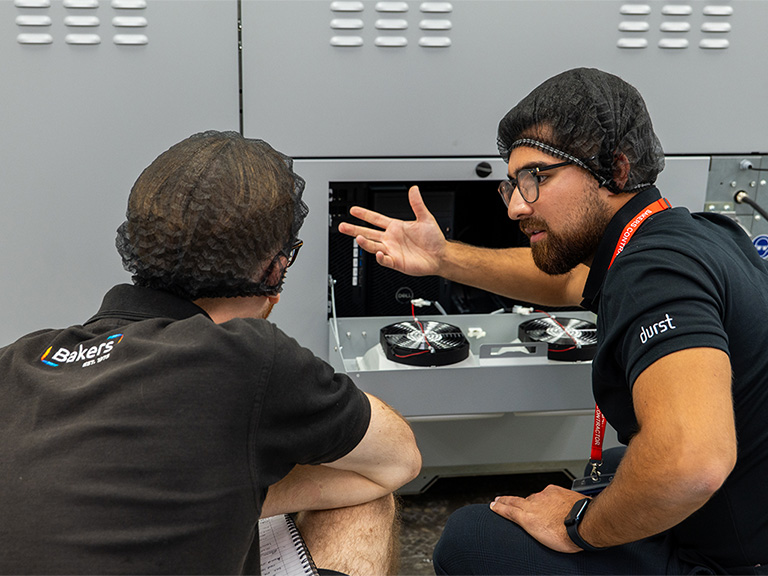
The press arrives in several sections, which then have to be positioned and levelled accurately before the engineers can begin connecting everything and working through their checks. Printheads, web alignment and tracking all need to be tested before the machine gets anywhere near a customer job.
Once the engineering work was complete, the Durst team moved on to training our own operators.
Over the following days, they worked alongside Jamie Godson and the production team, running test material, learning the new controls and gradually introducing live work.
A UK first for Bakers and Durst
Being the first Tau G3 Peak installation in the UK adds another dimension to the investment.
Simon Cosh, UKI Business Development Manager for Durst, visited us once the installation was under way, which gave us the chance to talk about the relationship between Bakers and Durst and what it means for a customer to return for a second machine.
As Simon put it:
“It’s obviously a positive statement in terms of how successful the first press has been. Otherwise, you wouldn’t have been discussing a second press.”
That works both ways. We wouldn’t make another investment of this scale unless the technology had already proved itself to us, while for Durst, seeing an existing customer invest again is a useful endorsement of what the equipment is delivering in a working production environment.
Simon also spoke about what having Baker Labels as the first UK installation means to Durst:
“For us, it’s fantastic to have our technology endorsed by Bakers. Your reputation goes before you in the marketplace, so that endorsement is a massive boost for us.”
Adding capacity without losing flexibility
The new G3 Peak isn’t here to replace our existing Durst.
Instead, the two machines will work alongside one another, giving the production team more than double the previous capacity on the Durst platform, as well as valuable redundancy when jobs are being scheduled through the factory.
That resilience matters almost as much as the extra output. Two presses give us more freedom to react when production priorities change, while still keeping the fast turnaround times our customers expect.
Tom Baker summed up the thinking behind the investment during his conversation with Simon:
“It’s not one big thing. It’s just a combination.”
Jamie Godson’s description was even shorter:
“Two words: continuous improvement.”
That probably sums up the thinking behind the investment better than a long list of specifications.
Yes, the new press is faster. It’s wider. There’s more automation and new technology built into it. But the real value comes from how all of those things work together in production and what that allows us to do for customers.
For Bakers, continued investment has always been about making sure we have the capacity and equipment to keep pace with the work coming through the business while maintaining the quality and service our trade customers expect.
This is another step in that process.
Now the real work starts
The installation may be finished, but there is still plenty happening around the G3 Peak.
Our operators are getting used to the updated interface and the technical team is completing profiling and fine-tuning, but the core Tau platform is already familiar territory. That means the G3 has been able to move into live production quickly.
For now, though, it’s good to see the UK’s first Durst Tau G3 Peak doing what we bought it to do: printing labels.
Talk to Baker Labels
If you have a label project you’d like to discuss, from short digital runs and multiple SKUs through to larger volume requirements, talk to the Baker Labels team.