
As part of our latest round of Bakers Foundation donations, we’ve donated £2,000 to Essex Wildlife Trust, specifically supporting its Amazing Grazing appeal.
But rather than simply handing over a donation, we had the opportunity to find out exactly what Amazing Grazing looks like in practice.
It involved a trip to Blue House Farm Nature Reserve in North Fambridge, a bale of hay and some very enthusiastic cows and sheep.
Our PR & Marketing Manager Kirsty Dailly joined Grant Maton, Corporate Communications Officer at Essex Wildlife Trust, and met Conservation Grazing Officers Ethan Pinion and Yasmin Arslan, who explained how livestock are helping to manage and protect some of Essex’s most important habitats.
What is conservation grazing?
It turns out that cows and sheep can be extremely effective conservation workers.
Conservation grazing uses livestock to manage grasslands naturally, recreating some of the effects that large grazing animals would traditionally have had on the landscape.
Different animals graze in different ways. Cattle browse and tear at vegetation, while sheep can graze much closer to the ground. Moving different breeds around Essex Wildlife Trust’s reserves helps create a varied landscape rather than one uniform height of vegetation.
That variety creates better conditions for wildflowers, insects, birds, reptiles and mammals.
It also means that sensitive grassland can be managed without relying solely on mowing and other mechanical methods.
As Ethan and Yasmin explained during our visit, even what the animals leave behind has a role to play. Dung provides food for invertebrates and returns nutrients to the soil, making the livestock part of a much bigger natural cycle.
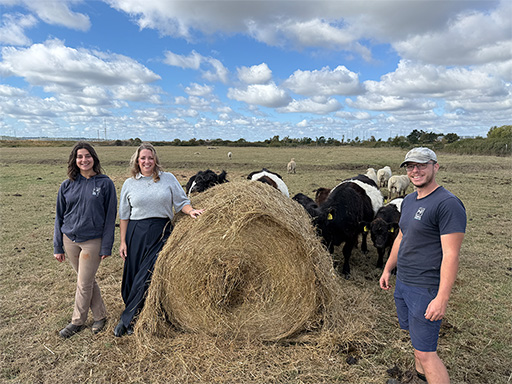
Conservation Grazing Officers Yasmin and Ethan with Kirsty Dailly, PR & Marketing Manager.
Supporting the Amazing Grazing appeal
More than 25% of Essex Wildlife Trust’s nature reserves need conservation grazing, and running the programme is a significant undertaking.
The Trust’s Amazing Grazing appeal aims to raise £125,000 towards the £250,000 annual cost of its conservation grazing operation.
The funding helps to cover the everyday realities of caring for around 400 traditional-breed cows and sheep across Essex: nutritious food, veterinary care, daily welfare checks, lambing and calving support, specialist transport equipment and the skilled conservation grazing staff who look after them.
The livestock are moved between reserves according to the needs of each habitat, with different breeds selected for different types of terrain.
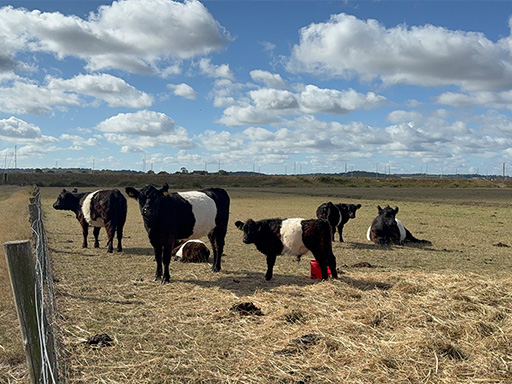
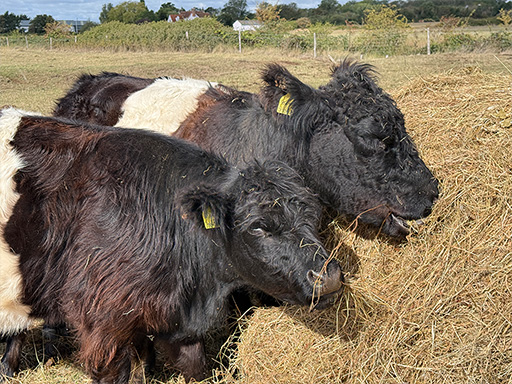
At Blue House Farm we met some of the Trust’s Belted Galloway cattle. These smaller, hardy cattle are particularly useful on more delicate sites where a lighter animal is better suited to the ground.
Alongside helping to manage habitats, the Trust’s use of traditional breeds also contributes to keeping native and heritage livestock breeds part of our countryside.
Visiting Blue House Farm Nature Reserve
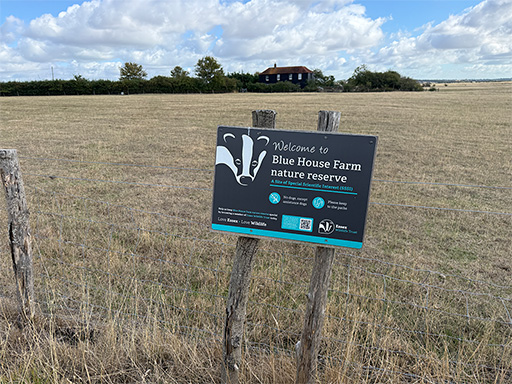
Blue House Farm is a 287-hectare nature reserve alongside the River Crouch at North Fambridge and provides an important mix of coastal grazing marsh and wetland habitat.
It is especially important for birds. During the winter, the reserve becomes home to large numbers of dark-bellied brent geese following their migration from Siberia, alongside wigeon and other wildfowl and wading birds.
The livestock have their own important role in maintaining the grassland these species depend upon.
Seeing that work first-hand — and getting into the fields to help Ethan and Yasmin distribute some hay — made it much easier to understand how many different elements sit behind the words conservation grazing.
The cows and sheep might make it look fairly effortless. There’s actually an enormous amount of planning, expertise and care behind keeping both the animals and the habitats healthy.
Supporting conservation in Essex
Essex Wildlife Trust is one of the many organisations Bakers Foundation has been pleased to support as part of our commitment to charities, community groups and good causes.
For us, this is exactly the type of project we love learning more about: practical conservation happening here in Essex, led by people who genuinely understand and care about the landscapes and wildlife they are protecting.
We’re delighted that our £2,000 donation to the Amazing Grazing appeal can play a small part in keeping Essex Wildlife Trust’s four-legged conservation team grazing — and Essex’s wild spaces thriving.
Find out more about Essex Wildlife Trust’s Amazing Grazing appeal and how you can support it.